

If you’re one of the new readers who subscribed after reading about a bunch of books I didn’t enjoy, welcome! I mostly write about books, although every once in a while I’ll write a personal essay or share something completely unhinged. You can read a little more about me here. Every month I post a recap of the books I read. I’m glad to have you here!
When the year started, I blocked off enough pages in my bullet journal to chronicle my reading of up to 200 books. I have read that many books in one year before, but I knew it was probably going to be a stretch, and the year turned out to be even crazier than I anticipated (and it’s not even over yet). Here’s a fun little graph I made showing the number of books I’ve read each month.1
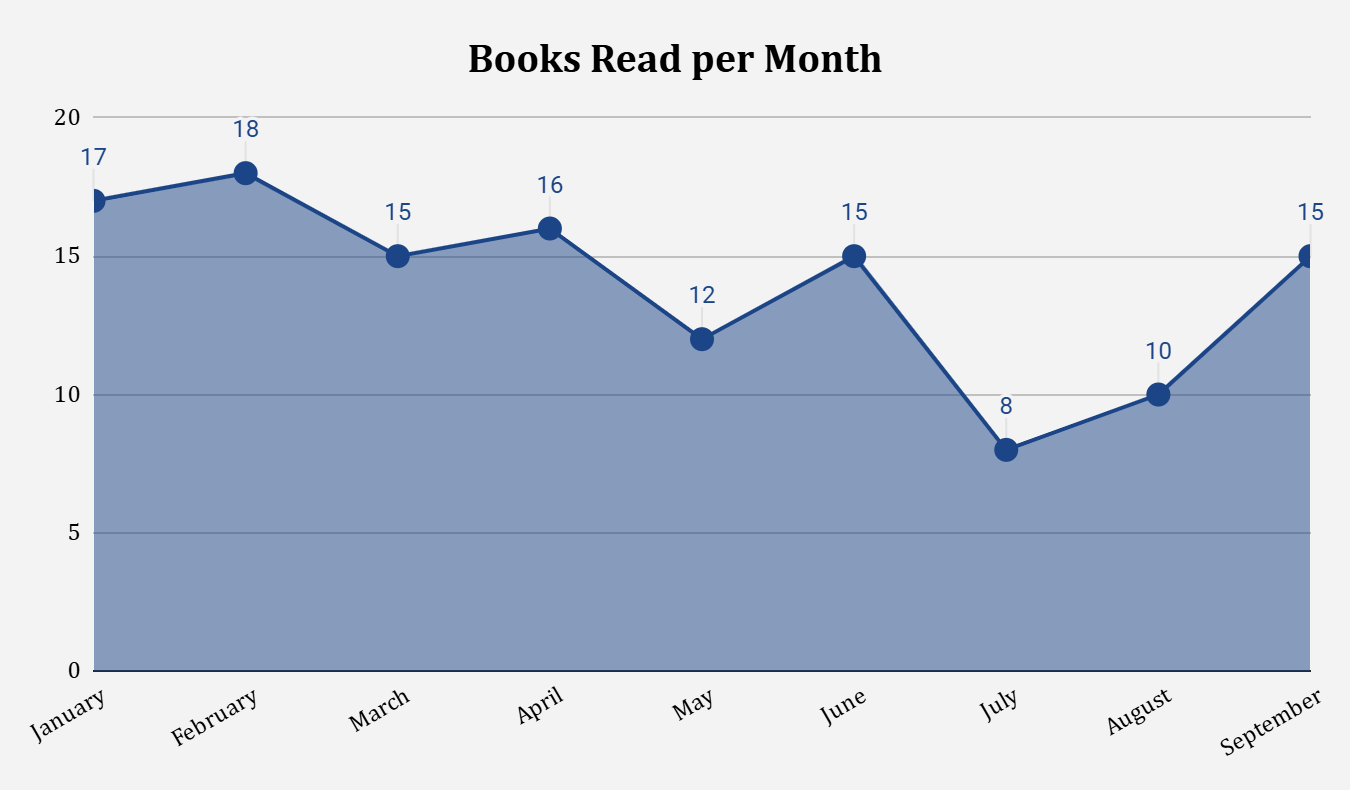
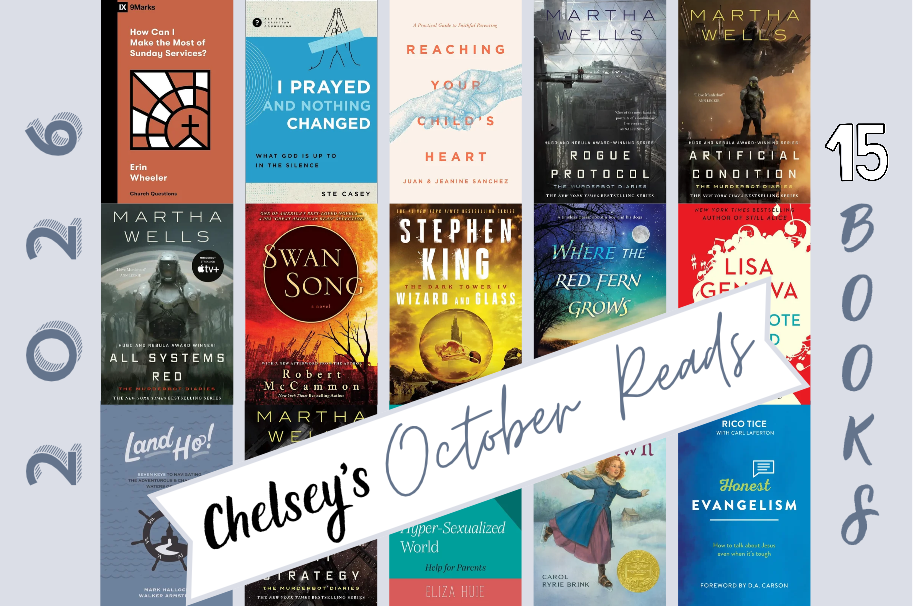
This month I read 15 books, which is slightly more than my average books per month this year, which is 14.1. I’m about halfway through the 8th page of my book tracker in my bullet journal.
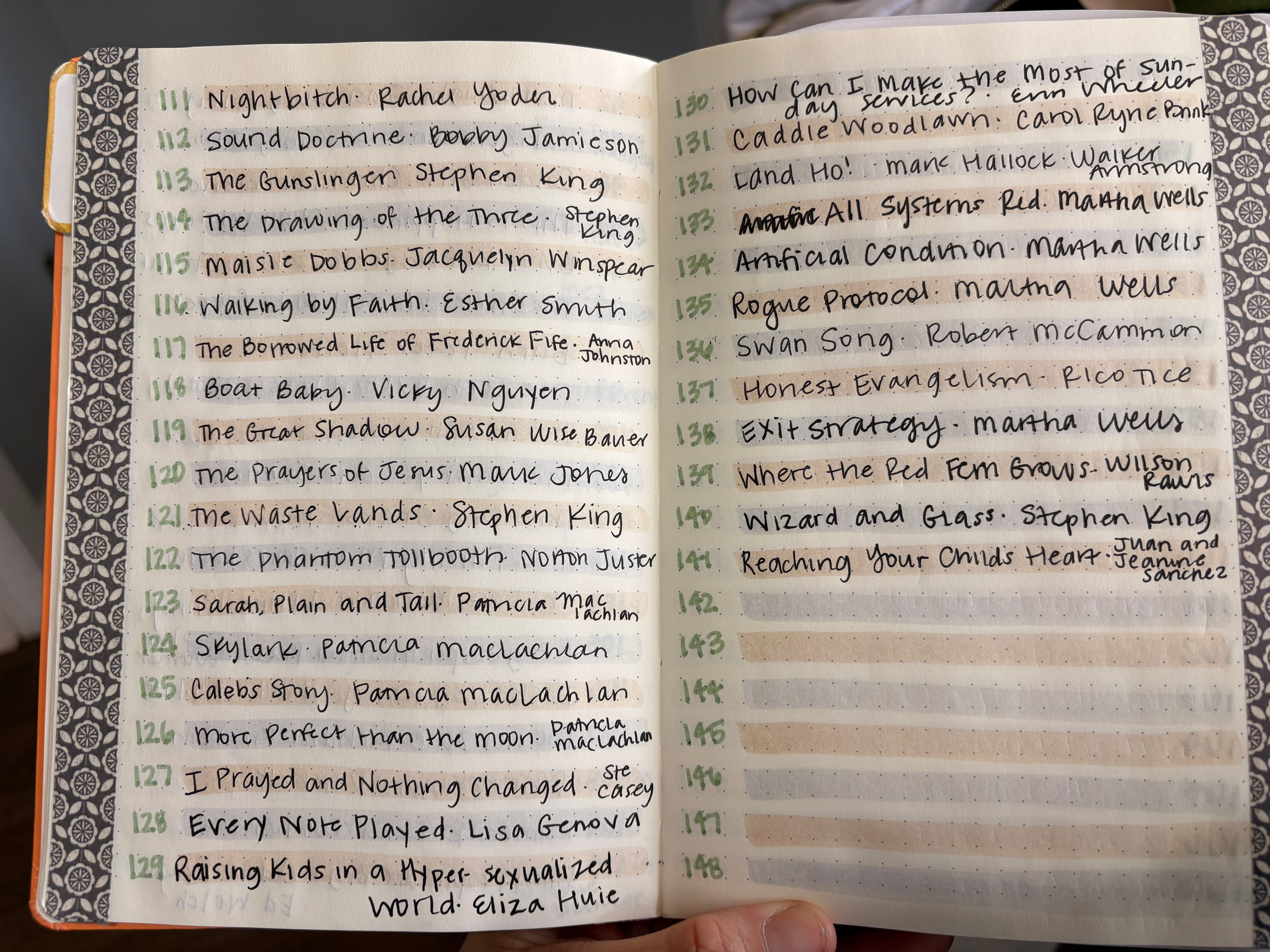
While reading 14-15 books in both November and December will be nothing to scoff at, it’s going to put me right at about 170 books for the year. I’m not upset I won’t hit 200 books, because 1) I’m not trying to win a reading competition, 2) reading has brought me great joy all year, and 3) I’ve now added 170 books to my backlog of books to write about and include in reading roundups in the future, whether I liked them or not. I don’t tell myself that 170 books is really good because most people don’t read any books. Not everyone likes to read, and that’s OK. I do.
I will admit that some of the books I read this month were very short, but I also read two books that each approached more than 900 pages. If you average out my page counts, it was about 270 pages per book, which is nothing to sneeze at. I read just over 4,000 pages total, about 130 pages a day, while also making sure five other humans and myself were clothed and fed along with all the other things I have going on.
This month I have divided the books I read into 5 different categories, although the symmetrically-minded among you will be disappointed that it didn’t break down into 5 groups of 3.
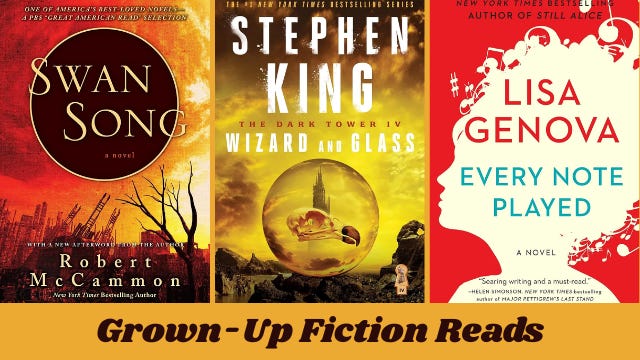
This book had been on my TBR for a while, but it wasn’t available on audiobook, so I was suspending and unsuspending my hold on the eBook while I was finishing up the first three books of The Dark Tower series.2 Before starting Wizard and Glass (see below), it became available. My husband and I were going to be traveling so I checked it out and began reading it on our long car ride. I read the entire book, all 860ish pages of it, in one day while playing passenger princess. I absolutely loved it and am grateful to whoever recommended it. It’s a post-apocalyptic nightmare of a tale that captured me in the same way Stephen King’s The Stand did the first time I read it.3 It also reminded me a lot of The Passage by Justin Cronin, so much so that I started to wonder how much of the book inspired Cronin’s series, to the point of being derivative. The world-ending event in Swan Song is nuclear war, while The Passage contains vampire-like beings who escape from a governmental facility, but both books center on a young girl who seems to have some kind of supernatural/magical abilities. If anyone out there has read both these books, please share your thoughts!
Wizard and Glass by Stephen King
It’s hard for me to put into words how much I love this book. This is the fourth book in Stephen King’s The Dark Tower series, but it is the only one of the books in the series that exists almost entirely in flashback. The protagonist of the series, Roland Deschain, has up until this point in the series kept much back from his traveling companions, but they finally convince him to tell the story of how he ended up as the last gunslinger, doomed to wander a world that has moved on. He goes back to when he was a teenager and his father sent him and his two best friends to a small community in order to keep them occupied during a tumultuous political climate, but the three teens find that the Bad Guy’s minions have already infiltrated the town. Worst of all, Roland falls in love with a young woman named Susan Delgado. You get many mentions of Susan before this book, and you know that she is someone important from his past, but in this book, you get the whole heartbreaking story. I told my husband after finishing it this time that it would make such an excellent movie, but it actually wouldn’t, because you can’t appreciate the book without having read the first three books and seeing what the trauma of Roland’s past has done to him, and I don’t trust anyone to do the series justice to that extent. Hollywood absolutely butchered their attempt to make the first book of the series into a movie, so I’d rather them keep their hands off this one.
Every Note Played by Lisa Genova
My book buddy Nichole recommended this one, and for some reason, I assumed it was non-fiction. I read the entire book thinking the author had interviewed the husband and wife in the story and written about their lives. There were a few times when my brain pinged me that something felt off for nonfiction, but I ignored it. It wasn’t until it was over that I realized it was entirely fiction, although the author’s goal was to increase awareness of ALS. This realization only slightly decreased my enjoyment of the book, which is about a famous pianist who develops ALS and slowly loses his ability to play the piano, and, eventually, to care for himself. He and his wife have been divorced for years, but through happenstance, she finds out about his diagnosis and becomes his full-time caregiver. For all the fiction books I haven’t enjoyed, this one was such a pleasant surprise.
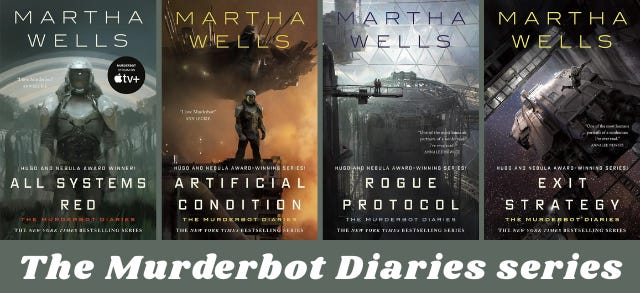
All Systems Red · Artificial Condition · Rogue Protocol · Exit Strategy
by Martha Wells
I finally started reading these after the encouragement of Faith the Writer, and I’m so glad I did. This series is told from the perspective of a “sec(urity)-unit,” a robot who contains some organic components and was created to go with humans on dangerous missions and protect them. This sec-unit, though, who calls himself Murderbot, has hacked the component that allows him to be controlled by humans and is now an independent being. These first four books are all pretty short, more like novellas, but the next book in the series, which I’m reading now, is a full-length novel. These books were quick listens and truly hilarious. I can only imagine that someone who is on the autism spectrum would find great comfort in the way Murderbot describes his relationship with humans—not that I’m comparing them to robots, but rather that the author manages to imbue Murderbot with incredible humanity even while he has a hard time understanding the social and emotional dynamics of the humans he finds himself forced to be with. I listened to the audiobook version of these books narrated by Kevin R. Free, and I think that’s probably the best way to experience them.
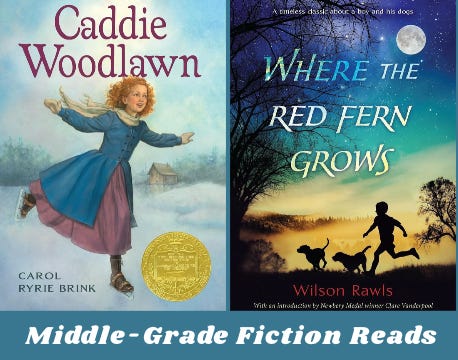
Caddie Woodlawn by Carol Ryrie Brink
I had such a good time revisiting Sarah, Plain, & Tall last month that I decided to read a few more books I remembered loving when I was a child. I think I read this book multiple times, and I also remember watching the movie version. At first, I wasn’t sure how well the book had aged given its depiction of the relationship between the white people and the Native Americans, because the word “savages” comes up a few times. Caddie’s family has a positive relationship with the Native Americans who live near them, but most of the town does not. Overall the book made me a little uncomfortable, but it wasn’t problematic enough that I couldn’t read it aloud to my kids and have intentional conversations about the content.
Where the Red Fern Grows by Wilson Rawls
I remembered this book was really sad at the end and it had something to do with hunting dogs, but that was about it. What a delight this book was to listen to. I can think of very few books written in the last 20 years that I’ve read, whether written for adults or children, that are as well-written as this book. The relationships between Billy and his dogs, between him and his parents, between him and his grandfather, between him and his sister—they are all beautiful. I also found myself also brought to tears at the appearance of a blue tick coonhound in the story. I never would have guessed 30 years ago when I read this book that one day we would have a blue tick of our own.4
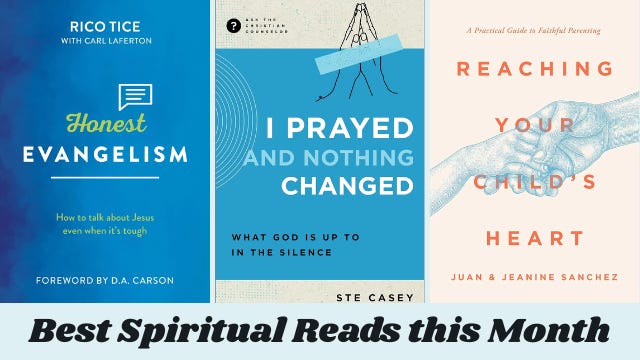
Honest Evangelism by Rico Tice
Our small group at church is currently going through a class called Christianity Explored, which the author of this book helped develop decades ago. He is a British evangelist who is one of the most winsome writers and speakers I’ve ever encountered on the topic of evangelism. Every Christian should read this book!
I Prayed and Nothing Changed: What God Is Up To in the Silence by Ste Casey
This is one of the best books on prayer I’ve ever read, and I have read a lot of books on prayer. After teaching an entire retreat on the topic of prayer, I found myself in a spiritually dark and lonely place for most of the spring and summer. Chronic pain has been my companion now for almost two years, and it began to wear on me in a way that was affecting me deeply. I felt like the author of this book could see right into what I was feeling and spoke to it with the truth of Scripture. This will be a book I reread and recommend to others.
Reaching Your Child’s Heart: A Practical Guide to Faithful Parenting by Juan and Jeanine Sanchez
This is a wonderful parenting book that I’d recommend to just about any Christian parent. That said, I have read a lot of parenting books and I didn’t feel it contained much new information; rather, it felt like it contained much of the best parenting advice from all the other books I’ve read. That’s not to say that they were plagiarizing. I just don’t think there is much new to say. If someone has not read much about parenting, I think this is a great book to start with.
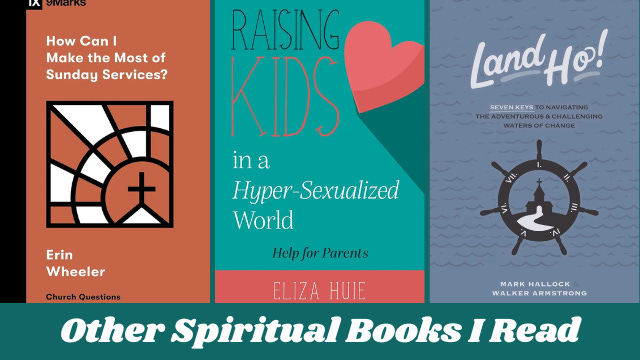
How Can I Make the Most of Sunday Services? by Erin Wheeler
This is a small booklet that I received at a retreat I went to last month. While it wasn’t mind-blowing for me, I think it would be a great resource for someone who is new to church or who is struggling with why it’s important to be at church on Sunday mornings.
Raising Kids in a Hyper-Sexualized World by Eliza Huie
This was another short little booklet that I think would be very helpful for parents who haven’t read much on this topic (or who don’t love long books!). I had encountered all the information in other books I’ve read, but it’s still a great little book.
Land Ho!: Seven Keys to Navigating the Adventurous & Challenging Waters of Change by Mark Hallock and Walker Armstrong
I’m torn on this book. On one hand, the content and principles were sound and I foud it helpful to think about in terms of our church. That said, the format of the book was that every chapter began with a dialogue between an experienced pastor and a younger pastor who was struggling with changing things at his church. I found it so incredibly cheesy I almost couldn’t finish the book. If that doesn’t bother you or if you think the topic would be helpful, I’d recommend it, but be forewarned.
That’s it for October! If you’re new here, I’d love to know your favorite genre. Whoever you are, let me know if you’ve read any of these books and the best (or worst) book you read this month. I’m here for the hot takes.
It never occurred to me to make graphs like this related to my reading but now that it has, GET EXCITED for all the end of the year recaps.
I usually have three books going: a spiritual/devotional book I read in the morning, an audiobook, and either a print book or eBook. If I try to do more than this at once I get jittery.
It is also perhaps even more disturbing than The Stand in terms of violence, so as usual, proceed at your own risk.
I went to get the link to the post about our dog, who passed away in March, and found myself reading the post again, remembering our giant goober of a dog. I miss him.