

Long-time readers will know of my deep love for nonfiction books. I truly could not say whether I prefer fiction or nonfiction—it just depends on my mood. Back in January I wrote a post called 25 Books Worth Reading that are 600 Pages or Longer, which turned out to be the most popular post I’ve ever published. It turned out lots of people love long books! That list contained both nonfiction and fiction, so a few weeks ago I made a list of 15 fiction books that were slightly shorter than those—all of them within 400-600 pages. And now, to complete the set, I’m sharing 15 fascinating nonfiction books between 400 and 600 pages long. We’ve got shipwrecks, wars, crime, and Star Wars—what more could you want?
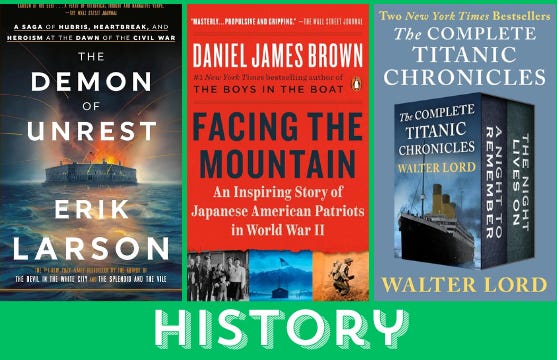
The Demon of Unrest: A Saga of Hubris, Heartbreak, and Heroism at the Dawn of the Civil War by Erik Larson
Erik Larson is one of my favorite nonfiction writers, but when this book came out, I wasn’t very excited. First of all, the Civil War is not one of my favorite time periods to read about. Also, it appeared as if the book only covered a few days of time, and I couldn’t imagine it would be all that interesting. Of course, I was wrong, because it’s Erik Larson, and it turned out to be a riveting story of how the war started. What was most interesting to me was that lack of communication was the reason behind most of what happened. If you’ve already read this one, my favorite Larson book is Dead Wake: The Last Crossing of the Lusitania.
Facing the Mountain: A True Story of Japanese American Heroes in World War II by Daniel James Brown
This was one of the first books I ever read about Japanese internment during World War II. I realized after finishing it that most of what I had known about it prior to the book had come from the winners—in other words, I had only read about it from a strictly Allied point of view. Without all the facts, it seemed somewhat reasonable to me that the Americans were afraid of anyone of Japanese descent after Pearl Harbor. This book soundly crushed that perspective as it followed several different second-generation Japanese immigrants and their experience during World War II. This book is just one example of why I love reading—I learn new things and my thinking about various situations gets turned on its head.
The Indifferent Stars Above: The Harrowing Story of a Donner Party Bride is my favorite book by Brown, but The Boys in the Boat: Nine Americans and Their Epic Quest for Gold at the 1936 Berlin Olympics is also good.
The Complete Titanic Chronicles: A Night to Remember and The Night Lives On by Walter Lord
This is technically two books in one, so it’s a little bit cheating to include it, but you won’t want to stop after the first one, so plan to read them both. Who isn’t fascinated by the Titanic? The movie came out when I was in high school and I think the most famous shipwreck in history has a bit of a chokehold on millenials. This book was written not long after the shipwreck, so the book itself is a snapshot of history as well as a thorough description and analysis of the event.
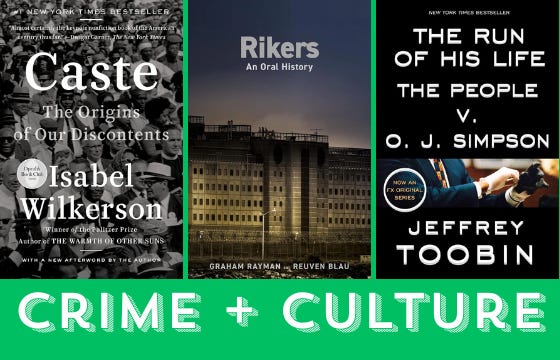
Caste: The Origins of Our Discontents by Isabel Wilkerson
When you hear the word caste, you might think of the social hierarchy in India, but the author of this book presents a compelling argument as to how a caste system also exists in the United States. This is a book that may cause you to reconsider your opinions and perspectives when it comes to race, poverty, and crime, so read at your own risk (but seriously, read it!).
And, of course, if you haven’t already read it, I can’t commend highly enough her other book, The Warmth of Other Suns: The Epic Story of America’s Great Migration.
Rikers: An Oral History by Graham Rayman
Oral histories are nothing new, but being able to listen to them in audiobook format is. I grew to love oral histories through the books of Garrett M. Graff, and so this one caught my eye. This is a heartbreaking look at the criminal justice system. It also continually made me think of all the time Rikers is a setting on Law and Order: SVU, a show of which I watched the first 10-12 seasons (basically until Stabler left—not interested after that).
The Run of His Life: The People v. O.J. Simpson by Jeffrey Toobin
This was the first Jeffrey Toobin book I read, and I became a fan almost instantly. I’ve read three out of four of his most recent published books (his newest, The Pardon: The Politics of Presidential Mercy, is on my TBR). He wrote this book in 1996, not long after the trial, but it is a detailed account of the crime, the aftermath, and the trial. The miniseries The People vs. O.J. Simpson: American Crime Story is based on Toobin’s book and you probably won’t be surprised to learn I watched it almost immediately upon finishing the book.
Memoirs and biographies are often grouped into the same genre, but they aren’t exactly the same. What’s the difference? Well, a memoir is written by the person in question about a period of his or her life, usually with a good deal self-reflection. This period could be a large swath of the author’s life but is not their entire life—otherwise it would be an autobiography. A biography is not written by the book’s subject and covers most, if not all, of his or her life.
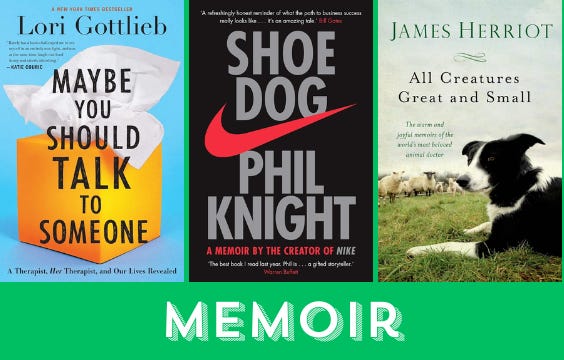
Maybe You Should Talk to Someone: A Therapist, HER Therapist, and Our Lives Revealed by Lori Gottlieb
I started going to counseling regularly when I was 29 years old, and it has been one of the primary reasons, secondary to the grace of God, that I have not gone absolutely insane. This book is a fascinating look behind the scenes at what it’s like to be a therapist.
Shoe Dog: A Memoir by the Creator of Nike by Phil Knight
I don’t care much about shoes or sports or brands, but this book was still interesting to me. The creator of Nike writes about the first 18 years of the business, which he started in 1962 when he was 24 years old.
All Creatures Great and Small by James Herriot
I read this book as a young adult, but I recently gave it a re-read. It is a charming and hilarious yet serious account of a young and inexperienced veterinarian trying to gain his footing in the English countryside in the late 1930s. It’s purportedly about animals, but it’s really about people and their relationships.
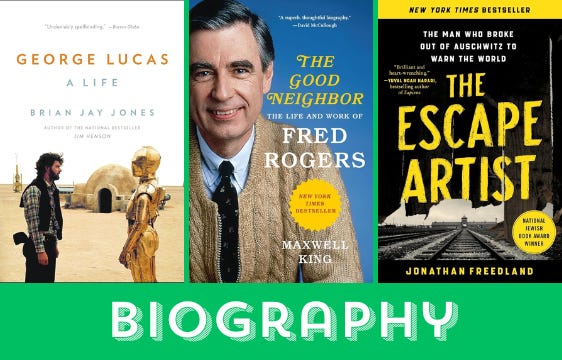
George Lucas: A Life by Brian Jay Jones
Growing up, I lived a sheltered life when it came to media. I watched Disney movies and PBS in elementary school, with one exception—Star Wars. My dad was 15 when the first movie came out, and while he never had any sons to pass his love on to, he found a welcome receptacle in his oldest daughter. I think this book would be interesting even if you aren’t a Star Wars fan, because George Lucas did a lot of other stuff as well.1
If Star Wars isn’t your thing, I also loved the author’s books on Dr. Seuss and Jim Henson.
The Good Neighbor: The Life and Work of Fred Rogers by Maxwell King
Mister Rogers’ neighborhood was a huge part of my childhood, as I think it was for many people in my age group. I loved reading about his life.
The Escape Artist: The Man Who Broke Out of Auschwitz to Warn the World by Jonathan Freedland
My passion for Holocaust history led me to this book, which is a terrifying and sobering account of a Jewish man who actually managed to escape from Auschwitz. I had never even heard this story mentioned until I read this book, which was surprising given how many books I have read on the subject.
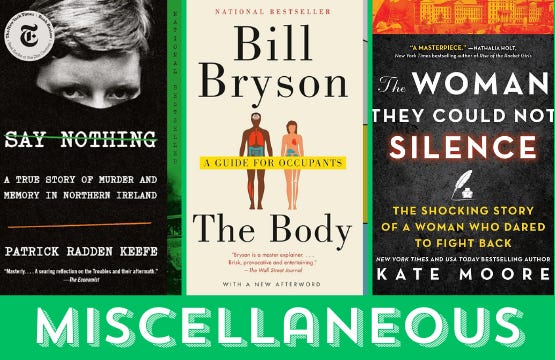
Say Nothing: A True Story of Murder and Memory in Northern Ireland by Patrick Radden Keefe
I’m not going to say much about Keefe’s books because I’m planning to write more about him in my April reading recap, but he is an incredible writer and this book educated me on a period of time I knew nothing about.
The Body: A Guide for Occupants by Bill Bryson
If you’ve never read anything by Bryson, this is a great place to start. He weaves anecdotes and stories with scientific facts to produce an incredible look at the human body.
The Woman They Could Not Silence: One Woman, Her Incredible Fight for Freedom, and the Men Who Tried to Make Her Disappear by Kate Moore
This book made me really grateful that 1) my husband is not a monster and 2) I didn’t live in the 1860s. Did you know that husbands could still technically commit their wives to psychiatric hospitals until the 1980s? This book is a story about a woman who would not back done and who fought tenaciously for the right to be in control of her own life and body.
I’d love to know if you’ve read any of these, or if you have any long-ish nonfiction books you’d recommend to me!
Christian has encouraged me to start educating myself on pop culture by means of watching the first 9 seasons of The Simpsons. I’ve only just started, but I have already found a new favorite quote by Bart Simpson: “There are no good wars, with the following exceptions: the American Revolution, World War II, and the Star Wars trilogy.”
Looking forward to your Patrick Raddon Keefe article. Just finished London Falling. I am not a non-fiction fan, yet, but he could change that status. I am so engrossed by his stories that it is a surprise when i remember that i can look these people up on the internet!
I loved Dead Wake.