

I remember bustling around the kitchen in the first house we ever bought in Columbia, South Carolina, when our daughter was a baby. I had just discovered audiobooks and was venturing into the genre of narrative nonfiction. That day, I started listening to Say Nothing: A True Story of Murder and Memory in Northern Ireland by Patrick Radden Keefe, and while I did have to turn the speed down to 1.25x so as to be able to fully understand the Irish accent of the narrator, I was immersed.
I went on to read Keefe’s next two books, Empire of Pain: The Secret History of the Sackler Dynasty and Rogues: True Stories of Grifters, Killers, Rebels and Crooks, and whenever I think about his books, I find myself wondering when he will write another book. You can imagine my delight when I realized his newest book was published earlier this month. It only took a week or two for the audiobook to be available on Libby, and I dove right in. It was the best nonfiction book I read this month, and I’ll talk about it below, but it was just further confirmation to me that narrative nonfiction can be just as compelling as fiction, if not more. If you don’t think you like nonfiction, I hope you’ll give one of Keefe’s books a try.
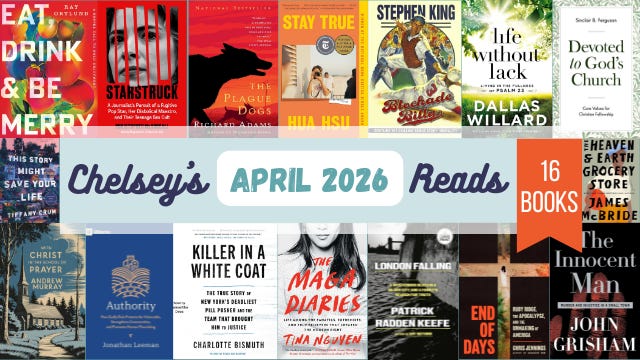
Zooming out, I managed to read 16 books this month—only one shy of my goal—but it was by the skin of my teeth. I read 9 books in the first half of the month, and 7 in the second half of the month, but I finished four of them in the last two days of April due to some marathon reading sessions. When I realized I was going to be several books shy of my goal, I decided to press on and finish two books that I’ve been plodding through for months. I wasn’t enjoying reading them anyway, so I forced myself to finish them so I could be done with them.1 Both of them were on my Kindle and now I can be free to enjoy a new book on my Kindle.
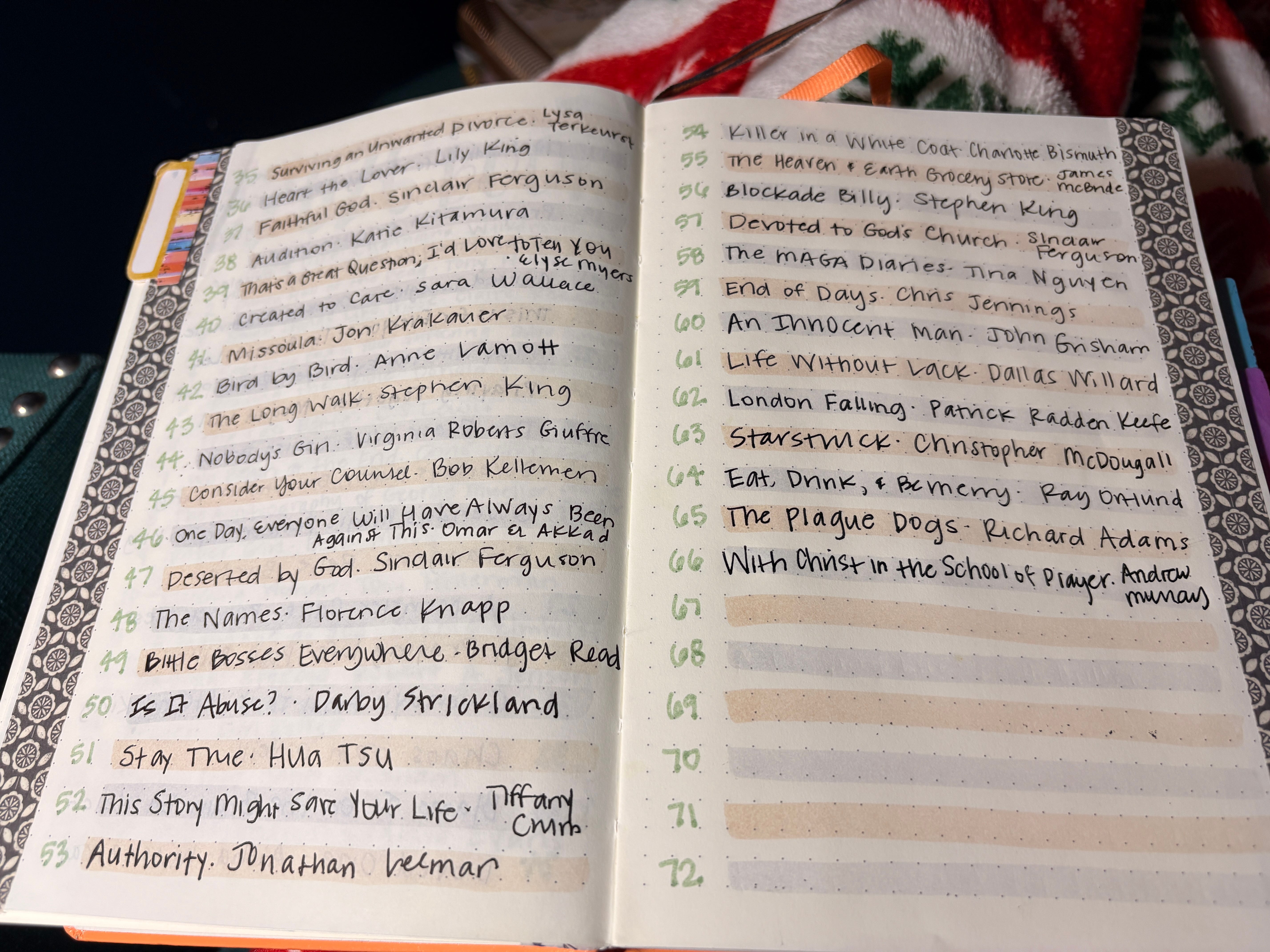
The reading slowdown was entirely due to starting a new part-time job and went from working about 6 hours a week to 20 hours a week. My free time has decreased and so has my reading. Additionally, I was exhausted at the end of the day and could not bring myself to read at all before bed. I am going to have to be much more intentional about reading going forward. (Challenge accepted!)
My monthly reads posts are very long. They are also my very favorite posts to write each month. I love revisiting what I read, considering what I thought about them, and pointing you to them as well as other books they reminded me of. If you find these posts interesting, would you consider becoming a paid subscriber? It’s only $5/month, and with all the other demands on my time, these paid subscriptions motivate me to keep carving out the time to write posts like these.
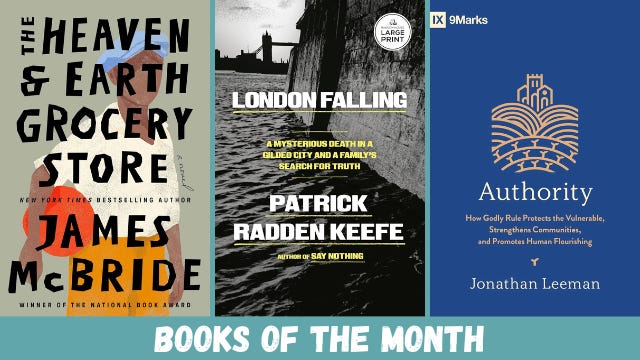
For the last while I have been picking one book in each category—fiction, nonfiction, and spiritual—and choosing the best in each. Think of it as a mini Academy Awards of books every month.
📗 The Heaven and Earth Grocery Store by James McBride
When I posted about the books I was taking on a trip earlier this month, several people mentioned how much they loved this book, so that was the one I started with. I flew through it in 24 hours thanks to the complete lack of obligations and found myself almost weeping by the end. It is a beautiful, hilarious, tragic book with memorable characters and one of the things that makes a fiction book five stars for me: the characters are dynamic, not static, changing and growing through what they experience.
📗London Falling: A Mysterious Death in a Gilded City and a Family’s Search for Truth by Patrick Radden Keefe
I was surprised when this book started out with talking about only one family. His other books have explored circumstances on a more macro level, and I wasn’t sure where he was going. It starts with the death of a 19-year-old boy that no one can explain, and the path to the answer involves Russian oligarchs, the Ugandan South Asian community, and a grieving mother and father. I listened to it every chance I got; if I had been reading the print version I think I would have flown through it even faster.
📗Authority: How Godly Rule Protects the Vulnerable, Strengthens Communities, and Promotes Human Flourishing by Jonathan Leeman
The title of this book might not sound all that thrilling, but if you are someone who has experienced abuses of power in your church, workplace, or home, this book will be a breath of fresh air. I felt affirmed when I revisited painful experiences from my past and compared them to how the author describes just and righteous behavior in those contexts. This is a book that I think every Christian should read.
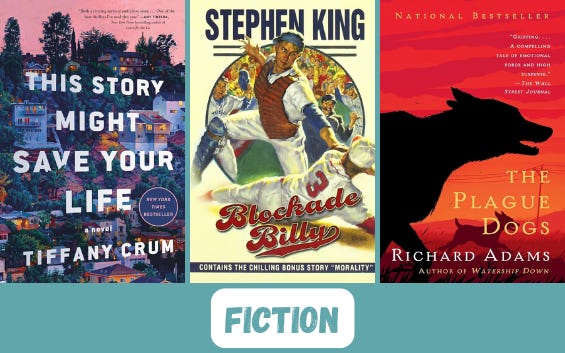
I only read four fiction books this month, and they were all very different. It was honestly a meh month for fiction—I tried many more than this and abandoned almost all of them (more on that below).
📗This Story Might Save Your Life by Tiffany Crum
New, somewhat popular books always make me nervous. I know I sound like a book snob, and maybe I am. I’m sorry. This book was a pleasant surprise. It’s about two friends, a man and a woman, who start a podcast together. Over the years, both of them get married, and the book is a back and forth from the present to the past. The book opens with the female podcast host and her husband going missing, and the rest of the book is the male host trying to sort out what happened. The audiobook had a male and female narrator for the respective chapters, and the chapters where their podcast was happening almost made me wish it was a real podcast!
📗Blockade Billy by Stephen King
This is a short book—a novella—that I also took on my out-of-town trip earlier this month. I’m trying to read through all of King’s works eventually, and this was waiting for me at the library right there on the shelf. It’s very short, but King still manages to pack a great deal of horror in a small number of pages. Despite not knowing or caring about baseball, I still managed to track with the baseball terminology.
📗The Plague Dogs by Richard Adams
I wanted to love this book so badly. I count Adams’ Watership Down among my top ten favorite books. A book about two dogs who escape from an animal research facility and are hunted because they are believed to be carrying the bubonic plague? It’s like it was written for me. Sadly, this book was difficult to read. There is a note at the beginning about the dialects that are used for some of the characters, and maybe if I were British it would have been easier to decipher, but there were whole paragraphs and pages I had to skim and guess at the meaning from context because they were unreadable to my Americanized brain. Additionally, there are so many references to places that had no meaning to me and thus only served to confuse me further. The seemingly hand-drawn maps were not helpful. There is also a good bit of commentary on British bureaucracy, which was not relatable. The book is meant to be a subtle polemic at climate change, industrialization, bureaucracy, and animal experimentation, and while I “got” the jokes, I struggled to keep wanting to pick this up. That said, the ending of the story was wonderful. I just wish we had gotten there a lot faster and with a lot more familiar words.
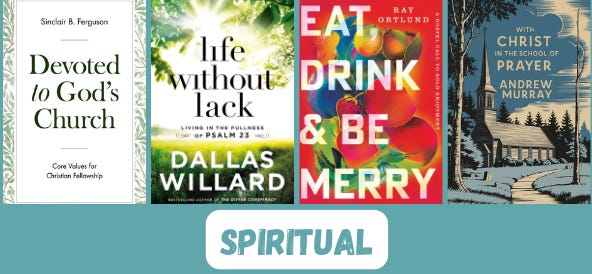
📗Devoted to God’s Church: Core Values for Christian Fellowship by Sinclair Ferguson
I only let myself pick one spiritual book as the best book of the month, and I was torn between this one and the one I chose. Dr. Ferguson is my favorite Christian author, my favorite pastor who isn’t my husband, and a man who has my greatest respect for his character, compassion, and integrity. This is a book every Christian should read. If you are involved in the local church, it will give you great encouragement. If you aren’t, it will challenge you without guilt, but by showing you how wonderful it is to be part of a local body of believers and how that is how God designed it from the beginning.
📗Life Without Lack: Living in the Fullness of Psalm 23 by Dallas Willard
I bought this book at McKay’s in Nashville a few weeks ago because I hear Dallas Willard quoted all the time but had never read anything he’d written. I found myself profoundly disappointed after finishing the book. While Willard had a lot of good things to say, I found that he treated his own speculations as fact; that he made claims about what God thinks and wants that were not based on Scripture; and that he failed to explain the gospel. As a result, I would not recommend this book to anyone. That said, a day or so after I finishing it, I ran across this article by Scot McKnight which helped me understand better where Dallas Willard fits into evangelical thought.
📗Eat, Drink & Be Merry: A Gospel Call to Pure Enjoyment by Ray Ortlund
My husband got several copies of this for our church’s free resource table, from which I grabbed a copy to read (I’ll now return it for someone else to read). He asked me what I thought and I told him Ortlund was just a little bit too happy and it got annoying. Being a bit of an Eeyore myself, I know I’m probably being too hard on the guy. It’s a good book, based out of Ecclesiastes, and the target audience is Gen Z-ers who are struggling with the meaning of life. My only other criticism is he quoted books written by two of his sons multiple times, and it started to feel like nepotism (or is it reverse nepotism?).
📗With Christ in the School of Prayer by Andrew Murray
I started this book waaaay back in February when I was preparing to teach at our women’s retreat at church. I was also reading numerous other books on prayer and didn’t finish this one. It is a solid book, but it would be best read one chapter a day consistently for a month. It took me three months to read 31 chapters and I jammed the last many into the last week just to finish it. It got pretty redundant by the end, but it was still an encouraging book.
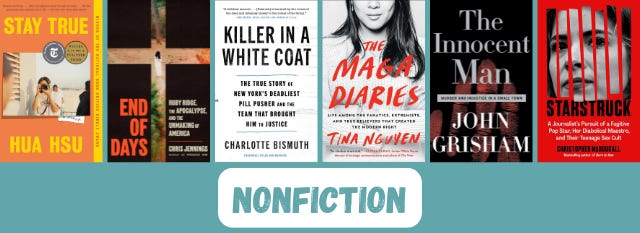
In lieu of anything better, I have listed the nonfiction books I read this month in order of shortest subtitle to longest subtitle—because seriously, subtitles are getting out of hand.
📗Stay True: A Memoir by Hua Hsu
Kudos to Mr. Hsu for choosing an extremely short subtitle. I can’t remember how I ran across this book, but I love a memoir and the author’s background looked interesting. It is the story of him growing up in America as the son of immigrants and of a tragic situation that occurred when he was a young adult. While I certainly am not trying to judge his experience or his response to the tragedy, I wasn’t ever really excited to keep reading. It was fine.
📗The Innocent Man: Murder and Injustice in a Small Town by John Grisham
John Grisham is one of my favorite fiction authors, and I had no idea he wrote a nonfiction book two decades ago. This is the story of a great injustice, of a wrongful conviction that sent a man to death row for more than a decade. However, the middle of this book got really bogged down. I think Grisham the fiction writer was trying to include more intrigue in his nonfiction book when he’d have been better off cutting the length of the book down by about a third. That said, it was still a compelling story.
📗End of Days: Ruby Ridge, the Apocalypse, and the Unmaking of America by Chris Jennings
Chelsey, how many more books do you plan to read about Ruby Ridge? Well, this will probably be the last one. I think I pretty much have the timeline memorized at this point. While this book zoomed out and looked at greater cultural and religious trends in the 80s and 90s, I think the better book on the tragedy is still Jess Walter’s Ruby Ridge: The Truth and Tragedy of the Randy Weaver Family. In fact, Jennings quotes Walter’s book a good bit in this book.
📗The MAGA Diaries: Life Among the Fanatics, Extremists, and True Believers that Created the Modern Right by Tina Nguyen
This was an interesting book written by a woman who spent her formative years in far-right Republican circles. What I appreciated most about this book was that she treated both sides of the political aisle fairly. She did not disparage anyone; she simply stated the facts and described her experiences from her own point of view. If this aspect of American politics interests you, I’d recommend this one.
📗Killer in a White Coat: The True Story of New York’s Deadliest Pill Pusher and the Team that Brought Him to Justice by Charlotte Bismuth
I think this was my least favorite nonfiction book this month. The story that the book is purportedly about is fascinating—a doctor who used his weekends to sell prescription drugs to vulnerable people so he could pocket the money. But the book was a slog because the author interspersed details of her personal life what felt like every other chapter. There would be a chapter about investigating an aspect of the case, and then the next chapter would be about how her children were coping with the aftermath of her divorce. Perhaps she saw this book as a memoir, and in that case, the format makes more sense, but that is not how the book presents itself at the beginning, and I found myself more and more annoyed at her as the book went on.
Also, the book was originally published with the title Bad Medicine: Catching New York’s Deadliest Pill Pusher in 2021, but the audiobook, Kindle version, and paperback all have the newer title listed above, so keep that in mind depending on what version you want to read.
📗Starstruck: A Journalist’s Pursuit of a Fugitive Pop Star, Her Diabolical Maestro, and Their Teenage Sex Cult by Christopher McDougall
This almost became my top nonfiction book of the month. The word “cult” in the subtitle caught my eye. I had no idea who Gloria Trevi was until I read this book, and it was a horrifying read from start to finish. Gloria and her manager Sergio Astrade were basically the Ghislaine Maxwell and Jeffrey Epstein of Mexico in the 1990s, but possibly outdid Epstein and Maxwell in their cruelty and abuse. I am done reading about sexual abuse for a while.
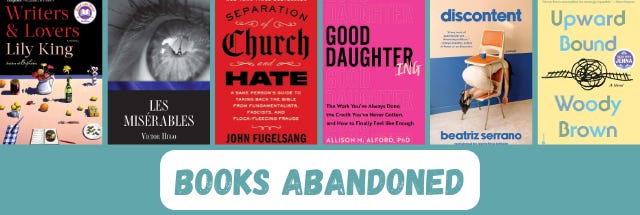
This Substack is a place where those who abandon books can feel safe. Every month I end up DNF’ing at least a few books. This month felt like it had more than usual, probably because I abandoned the give audiobooks one after another before I settled on one I wanted to finish.
📙 Writers & Lovers by Lily King—I read Heart the Lover last month, and it was fine, but I heard this one was better. There was some sexual content in HTL but not enough to make me discard the book. This one had more than I wanted to read in the first 10% of the book.
📙Les Misérables by Victor Hugo—after making it only 4% through the book in 4 months, I have accepted the fact that this is not the season of my life when I will be able to dive into a classic. One day, when my kids don’t have to be driven everywhere and my brain is less scattered, I will try again.
📙 Separation of Church and Hate: A Sane Person’s Guide to Taking Back the Bible from Fundamentalists, Fascists, and Flock-Fleecing Frauds by John Fugelsang—Books about religion often appeal to me, and I’m not opposed to reading a book by someone who doesn’t have the same religious views at me. But I felt like this book was not going to give Christianity a fair representation. To be clear, I am opposed to Christian nationalism, spiritually abusive pastors, and anyone who claims the name of Christ while behaving in ways opposed to Scripture. If the topics of evangelicals in America in the current age is of interest to you, I’d recommend The Kingdom, the Power, and the Glory: American Evangelicals in an Age of Extremism by Tim Alberta.
📙Good Daughtering: The Work You’ve Always Done, the Credit You’ve Never Gotten, and How to Finally Feel Like Enough – An Essential Guide for Adult Daughters to Navigate Family Dynamics and Boundaries by Allison M. Alford2 —I barely even started this, because after thinking about it, I realized I don’t really need to read this book. I am an oldest daughter, but I have good relationships with my parents and my sisters and in-laws.
📙Discontent by Beatriz Serrano—The premise of this sounded interesting but there was too much sexual content in the first few chapters for me to want to continue.
📙Upward Bound by Woody Brown—This was my biggest disappointment of the month. I first heard about this book on Ron Charles’ Substack, and having spent many years of my life working with individuals with autism, including some who were nonverbal, I was fascinated by the premise. However, while I was waiting for it to come available through Libby, I learned about controversy surrounding how the book was written. You can read more about the controversy in this article in The Atlantic (I think you’ll have to make a free account to read it). I made it through a few chapters and just felt icky. Feel free to give it a shot, but I couldn’t finish.
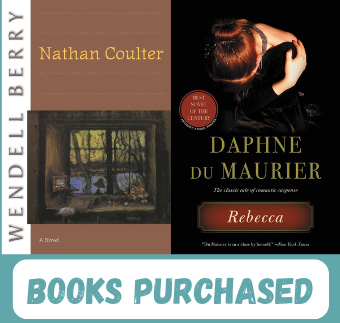
You can see some of the books I purchased in my post about my visit to McKay’s. In addition to those 5 books, I also bought the following:
📘Nathan Coulter by Wendell Berry—Berry’s book about Nathan’s wife, Hannah, is one of my favorite books of all time. I am excited to read this one, the first of Berry’s novels about characters in Port William. I bought the print version so I can start building a shelf collection.
📘Rebecca by Daphne de Maurier—This was a deal on the Kindle one day and I’ve heard so many people talk about it, I decided to grab it.
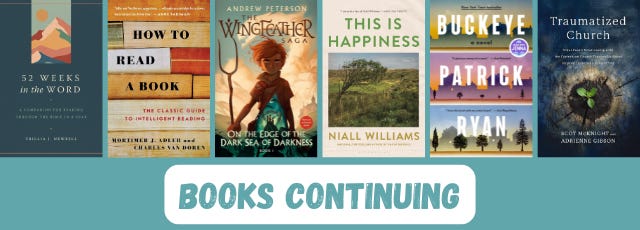
These are the books I’m carrying with me from April into May. I hope to finish at least three of these before the end of next month.
📖 52 Weeks in the Word: A Companion for Reading Through the Bible in a Year by Trillia Newbell (using to stay accountable to Scripture reading)
📖 How to Read a Book: The Classic Guide to Intelligent Reading by Mortimer J. Adler and Charles Van Doren (personal development)
📖 On the Edge of the Dark Sea of Darkness (The Wingfeather Saga #1) by Andrew Peterson (reading out loud to my kids)—I said in March that we’d finish this in April if it was the last thing I did. Well, it was not the last thing I did. We still have about 10 chapters to go. But my kids are engrossed and asking to read it. The problem is that at least half of the nights of the week, my husband or I are not home to read to them, or the kids have been up late at church or something else and we don’t have time. The good news it, when we start the second book, we’ll be almost to summer and we’ll be able to read more consistently!
📖 This is Happiness by Niall Williams—I started this on our trip to Tennessee and didn’t get far. I have two plane trips in the next month and I’m hoping this can be my airplane read.
📖 Buckeye by Patrick Ryan—I’m a quarter of the way through this one and I am eager to see where it’s going. I heard it recommended by a lot of people and so far it falls into the category of “sweeping family saga” that I love so much.
📖 Traumatized Church: What Paul’s Relationship with the Corinthian Church Teaches Us About Helping Those Who are Hurting by Scot McKnight and Adrienne Gibson—This is another one I’m borrowing from my husband’s shelf at work. I’m eager to hear Scot McKnight’s take on this subject.
If you made it this far, congratulations! What did you read this month? Have you read any of the ones I’ve mentioned here? How many books about Ruby Ridge have you read?
As always, engaging with you in the comments or over email is one of my favorite parts about this Substack. I’d love to hear rom you!
Many of you know that I have no problem DNF’ing books. These two, though, were ones I was far enough into when I found myself dragging that I decided to finish them. It was a choice.
Speaking of long subtitles—I think this book’s subtitle has its own subtitle? Things are getting out of hand, guys.
And I laughed out loud at your 66 vs 67 dilemma! 😆😂
Aren’t books the best?? I am slowly working my way through War and Peace by Leo Tolstoy, Regeneration by Pat Barker (WW1 was truly horrific), and The Stand by Stephen King. I just finished Dissolution by Nicholas Binge. It was pretty good, although a little heavy on the sci-fi for me. Loved the ending though!