

“Here’s how you can remember where Denmark is,” said Mr. F. “It’s the nipple on the breast of Europe.”
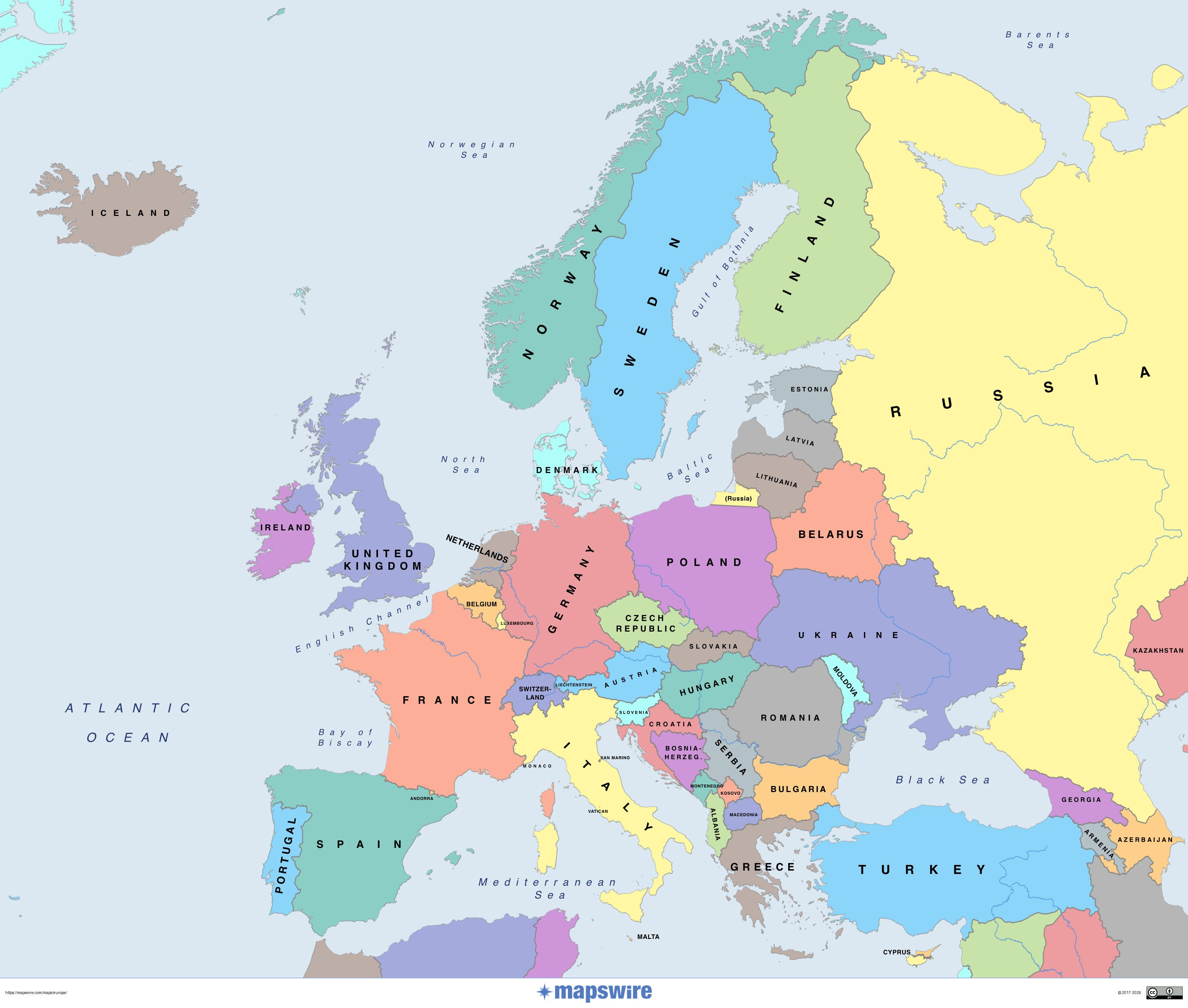
Anyone who had been losing interest in his introduction to European History immediately sat up straight. Some of us probably had mouths agape. We were 15 years old, at the beginning of our sophomore year of high school, and our teacher had just said the word nipple. He had our attention.
Mr. F. made everything interesting, whether he was talking about the branches of government or the French Revolution (one of his favorite time periods, because of all the executions). He also said outrageous things. That holiday season, when the school was doing a canned food drive, he told us that if we wanted to solve the hunger problem in our community, the best thing to do was not to bring canned food, because, he explained, if we didn’t keep feeding all the hungry people, they would eventually starve and die, and then there wouldn’t be so many hungry people.1
He was intentionally provocative and shared details about important people and events in history that we didn’t need to know, but that made us want him to keep talking. A former student had drawn a picture of Mr. F. in a guillotine, capturing the moment when his head was detaching from his body. He had this picture framed and hanging behind his desk. He also had a fascination with Rasputin, which I welcomed, having been obsessed with the film Anastasia earlier in my childhood.
He was known for being an extremely strict teacher with difficult test and quizzes, but most of his students went on to pass the AP exams based on his classes. He had a wonderful sense of humor but expected a lot. I had him for Government as an early morning class my senior year, and a girl had decided to finish applying her makeup in the first few minutes of class. Without stopping his lecture, he threw the dry eraser at her, not saying anything but communicating very clearly that what she was doing was not okay.
I loved his class for all of his weird stories and morbid interests, many of which imbued in me a love for history and nonfiction and quirky true stories. But the reason I really loved Mr. F. was because he seemed to get me.
I was what kids these days might call a tryhard,2 but I wasn’t trying to be a tryhard.3 I was doing the only thing I knew how to do, which was to push myself to do the absolute best I could do. I was all or nothing in anything I had committed myself to, and I was committed to school. I wasn’t doing it to get attention. It did garner attention at times, of course, and some of my other teachers, in an attempt to encourage me, would in various ways let some or all of my classmates know that I had made the very best grade on an assignment. They meant well, but it did not improve my social experience of high school. I was very content to work hard, make good grades, and fly under the radar.
As I got into my junior and senior year I immediately flipped over any assignment I got back so no one could see that I had scored an A, a 100, or, one time, a “1,000” — a little joke by my English literature teacher because I had written 32 pages comparing three different books when the essay only had to be 8-10 pages long.4
Without me ever telling him about any of this, though, Mr. F. seemed to understand my situation. He would always hand my papers back face down without any fanfare. There was another student in my class my senior year—we’ll call him Chad5—who saw me as his archnemesis when it came to grades. He wanted to graduate at the top of our class, and he perceived I might be his direct competition.6 We had the exact same schedule that year, so in every class, he was trying to get better grades than me. He was forever asking me what I got on everything, and I usually refused to tell him in hopes he would eventually give up.
One day, Mr. F. gave me back a test, face down, and Chad reached across the aisle and grabbed it off my desk. I don’t know if he got a chance to see my grade before Mr. F. swooped in out of nowhere and snatched it right out of Chad’s hand and gave me back my test. I don’t remember if Mr. F. even said anything, but I remember Chad’s face turning the color of a tomato. From then on, I was safe in Mr. F.’s class. He commanded so much respect merely by his presence that I don’t think Chad ever bothered me in any of our other classes after that, for fear it would make its way back to Mr. F.
I often got to school early my senior year, because I dropped my younger sister off at middle school on my way to school. I would sit in Mr. F.’s classroom, my first class of the day, and work on homework for other classes, study for tests, or just read. Sometimes, if he wasn’t preparing for class, we would chat. The content of most of those conversations has been lost to my memory, but I do remember one. Graduation was approaching, and maybe I mentioned that I wasn’t sure what I was going to study in college. He told me that he had my perfect career figured out: I should be on staff at an American embassy overseas, and I should be in charge of logistics, event management, and all the things that went into running an embassy.

You’ve probably already figured out that this was not the trajectory of my adult life, but that hasn’t changed the fact that I still remember when Mr. F. told me this, because it was less about what kind of job he thought I should have and more about what he was communicating: that he understood how my mind worked and that he thought there was something I would be really good at.
I had another teacher my senior year who I will call Mr. A. He was the antithesis of Mr. F. in all the ways that mattered. I had him for AP Calculus, and he thought he was very good at calculus. Whether he was or he wasn’t, I have no idea; what I do know is that he was very bad at teaching calculus to high school students. By the time I made it to my senior year, I was ranked number one in my class and had scored 5s on every AP exam I had taken so far. I had made very high grades in every math class up to this point. Calculus was a total mystery because Mr. A. was very bad at explaining things, no matter how many questions we asked.
Here is what would happen on test days: He would give us our tests, and the questions would feel impossible to answer because we had learned very little, and so everyone would stand in a line to ask him to help explain the question and, most of the time, compel him to explain it well enough to basically give the answer.
I stood in line for one or two tests until I figured out what was happening. Then, despite the anxiety of knowing I was probably sacrificing my grade in the class and subsequently my class rank, I refused to join the line. The reason for this decision was the look of pleasure on Mr. A.’s face when he was explaining calculus questions that we should have already understood if he had taught the class well. He seemed to find perverse happiness in seeing all of us, among the highest achieving students at our school, standing in a line that stretched half the perimeter of the classroom, waiting for him to descend from Mount Calculus and honor us with an explanation. I might have been imagining it, but I felt he took an especial delight when I got to his desk. It made me uncomfortable.
That was Calculus AB, but there was also Calculus BC, in the spring. I requested to drop Calculus BC from my schedule and the administration wouldn’t let me. There is something about schools getting funding if a certain number of students take AP classes, and something else about benefits if many students pass the exams. As a 17-year-old I couldn’t have cared less about that; I did care a lot about my grades, but I all I wanted was to be out of Mr. A.’s class. I eventually had an individual sit-down with the principal and told her in no uncertain terms that I did not want to be in his class in the spring.7 She relented, and instead of a block class of Calculus BC in the spring, I had a glorious 90-minute block in the morning where I could do homework or, if I played my cards right, go home and take a nap.
But I hadn’t seen the last of Mr. A. In the spring he got put on lunch duty, which meant he patrolled the hallways and guarded the doors to the hallways that were on the opposite lunch and still had classes. For all of my junior year and my senior year thus far, my friends and I would go to our chemistry teacher’s classroom to eat our lunch, even though it was on one of the “closed” hallways. We had permission to do this and we disturbed no one on our way down the hallway.
Mr. A. did not like this. I think he didn’t like that I had dropped his class; who knows how much of what I said about my reason for wanting out got back to him. Whenever he was on lunch duty, he would stop me and ask me to prove that I had permission to go down the hallway. It was inane and unnecessary. He only did it to me; not to my friends.
Earlier this year I read the book The Things We Never Say by Elizabeth Strout. It was a wonderful book in its own right, but it brought to mind Mr. F. most of all, as well as my English teacher my junior and senior years of high school, Mr. H. Those two men were amazing teachers who truly cared about their students. I was a nerdy, awkward, insecure teenage girl who loved to read and write and hadn’t really found my footing yet. They encouraged me, treated me like an adult, and gave me confidence in the things I was good at. Their voices were louder than the voices of many of my peers and some of my other teachers, for which I am so thankful.
Mr. A. couldn’t have been more opposite. He didn’t necessarily make me feel dumb, but he targeted me in a way that made me feel very small. I don’t think I was an arrogant person then, and I hope I’m not now, either, but I think he was the sort of person who just liked making other people feel small so he could feel larger.
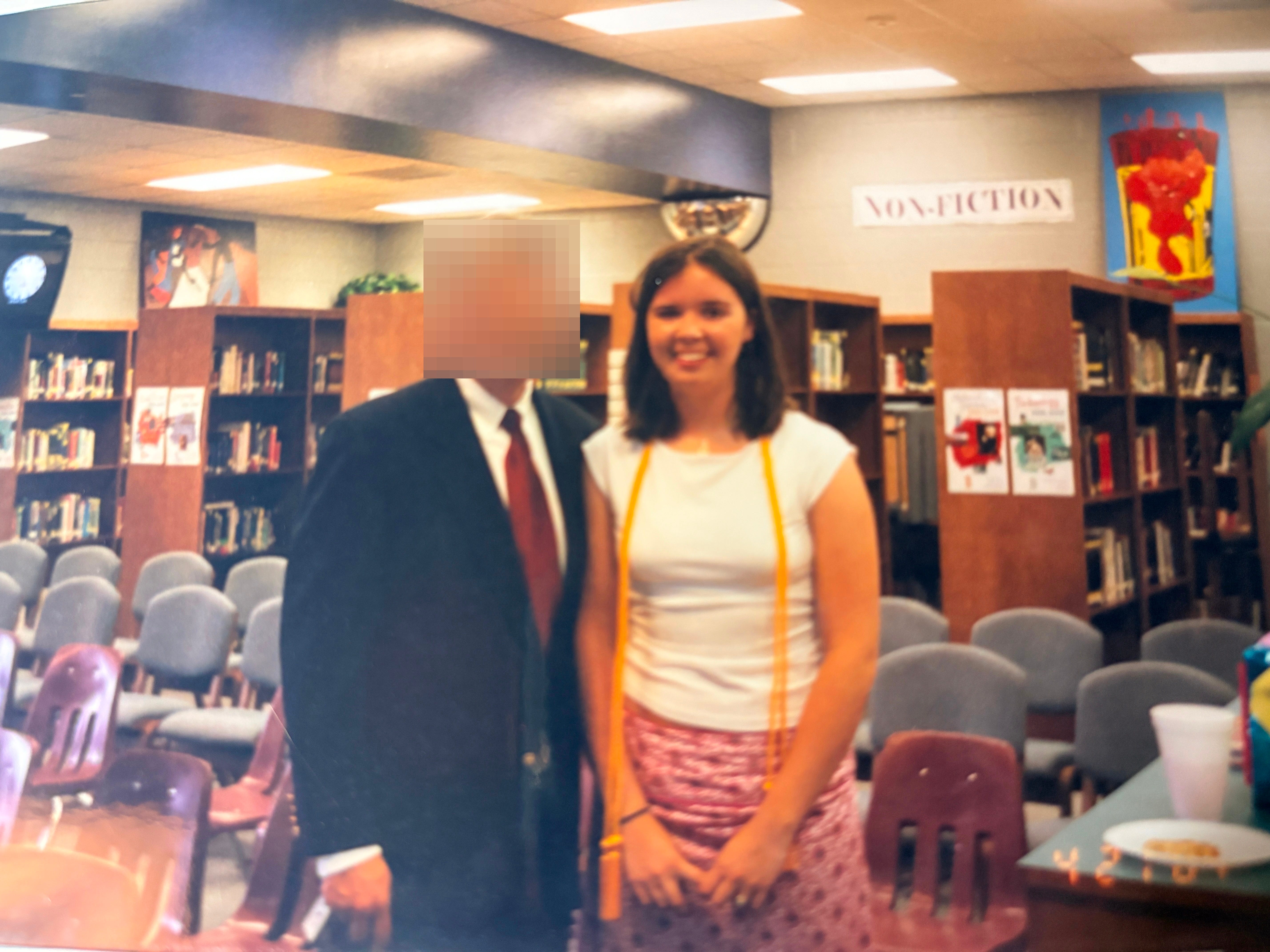
Mr. F. is approaching his 70s now, I think, and I wish I could find a way to tell him that he has been one of the positive voices in my head for the past 25 years. In looking for the picture above, I found in one of my old yearbooks where I had asked him to sign it. He wrote a short note in which he told me that I had his permission to “knock [Chad’s] block off” if I needed to.8
There are many things I could have written about for the week of Thanksgiving, and when I considered writing an essay about something I was thankful for, Mr. F. popped into my head. Now that I’ve written all this out, I’m on a mission to figure out how to contact him…
He assumed we were smart enough to know he was kidding. I’m not sure everyone did.
In case you’re not Gen Z, Urban Dictionary defines a tryhard as “someone who puts excessive effort and emotional investment into a game, activity, or social situation for the level of play or stakes involved.”
I recognize that is probably what a tryhard would say.
Once again, I was not trying to be a tryhard. It just took me 32 pages to say what I felt needed to be said.
Any of the connotations you have with the name Chad are applicable here.
He perceived correctly, and while it truly matters not at all at this point in my life, for those who are curious, I did outrank him at the end of high school.
I cannot express to you how much this was out of character for me. It reveals how uncomfortable I felt in Mr. A’s class that I had enough guts to put my foot down with the PRINICIPAL OF THE HIGH SCHOOL.
In today’s world, he probably would have gotten in trouble if he had written this, but I never showed the note to anyone who would have cared (such as Chad).
Russia will never know what it missed.